Borosilicate Glass NOx Scrubbers & NOx Absorption Systems
Goel Glass Inc. engineers and manufactures industrial and pilot-plant Borosilicate Glass gas scrubbing systems designed for the safe capture, absorption, and neutralization of toxic, acidic, and hazardous gas emissions. Fabricated in full compliance with DIN ISO 3585 and BS EN 1595 standards, our glass scrubbers provide complete visual process monitoring, zero metallic corrosion, and long service life across aggressive chemical processing applications.
Compatible Gases & Scrubbing Chemistry
Compatible Contaminant Gases
Engineered to scrub acidic vapors and hazardous halogens including:
- Nitrogen Oxides (NO, NO₂ / NOx)
- Hydrogen Chloride (HCl) & Chlorine (Cl₂)
- Sulfur Dioxide (SO₂) & Sulfur Trioxide (SO₃)
- Hydrogen Bromide (HBr) & Bromine (Br₂)
- Ammonia (NH₃) & volatile amines
Validated Absorption Media
Seamless compatibility with standard and oxidizing reagents:
- Aqueous Sodium Hydroxide (NaOH / Caustic)
- Water or dilute mineral acid (isothermal absorption)
- Hydrogen Peroxide (H₂O₂ / oxidative scrubbing)
- Sodium Bisulfite / Thiosulfate (reductive scrubbing)
- Organic or customized neutralization absorbents
Design Basis & Operational Safety
Each scrubbing unit features a vertical counter-current packed column packed with high-efficiency Borosilicate glass Raschig rings or PTFE saddles, providing maximum interfacial contact area with minimal pressure drop. A magnetic-drive fluoropolymer circulation pump continuously circulates neutralizing media from the bottom spherical reservoir vessel through an integrated glass coil cooler to remove exothermic heat of neutralization. The system includes an overhead mist eliminator / demister pad to prevent liquid droplet carryover into discharge vents.
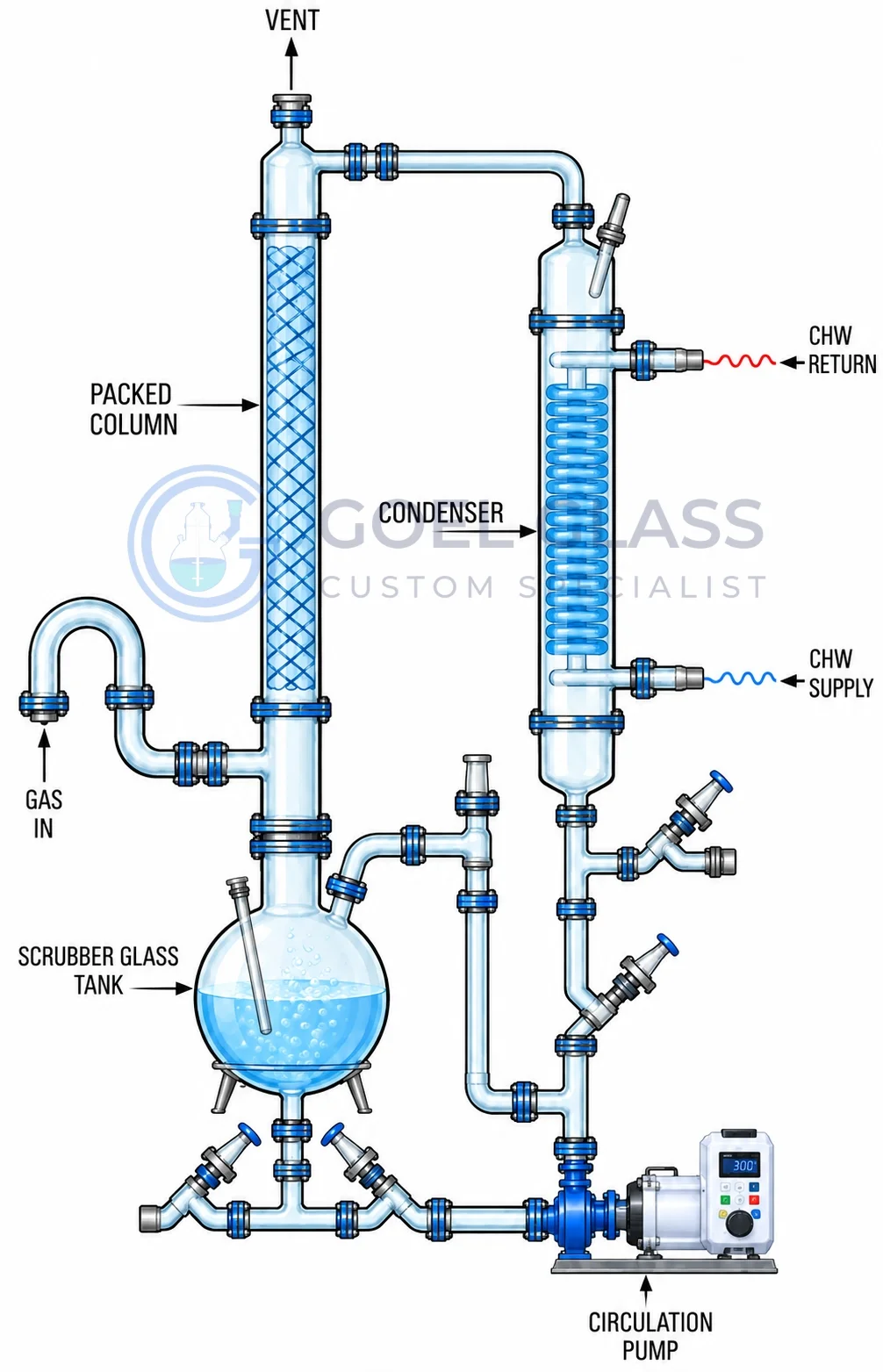
Standard Pilot Plant Scrubber Specifications (PGS Series)
| Model Ref. | Column Size | Reservoir Vessel | Circulation Cooler (m2) | Packing Height |
|---|---|---|---|---|
| PGS3 | DN 80 (80mm) | 20 L | 0.5 m2 | 1.0 m |
| PGS4 | DN 100 (100mm) | 50 L | 1.5 m2 | 1.5 m |
| PGS6 | DN 150 (150mm) | 100 L | 2.5 m2 | 2.0 m |
Your frequently asked question
Goel Glass NOx scrubbers provide exceptional resistance to mineral acid vapors (HCl, HBr, HNO₃, SO₂/SO₃), elemental halogens (Cl₂, Br₂), NOx emissions, and alkaline vapors (NH₃). All wetted contact parts are fabricated from chemically inert Borosilicate Glass 3.3 and virgin PTFE. Chemical compatibility with alkaline scrubbing media (such as aqueous NaOH or KOH solutions) is conditional on concentration, operating temperature, and process conditions: dilute caustic solutions (up to approximately 30% concentration) can be handled safely at ambient temperatures, whereas elevated temperatures or strong alkaline concentrations accelerate glass surface leaching. Borosilicate glass is not compatible with hydrofluoric acid (HF). Process engineering review is recommended for specific caustic temperature and concentration thresholds.
Unlike polypropylene (PP) or FRP scrubbers, Borosilicate Glass does not degrade, swell, or discolor when exposed to halogen gases or aromatic solvents, and it withstands exothermic reaction heat up to 100°C without softening. Glass provides total optical transparency, allowing operators to visually inspect packing wetting, liquid foaming, and circulation flow in real time.
Our scrubbers can be fitted with in-line pH sensors in the circulation line to trigger automated fresh reagent dosing, digital temperature probes on the reservoir and vent outlet, liquid level transmitters, differential pressure transmitters across the packing, and flameproof electrical switchgear.