Borosilicate Glass Reflux Dividers
Manually Operated Reflux Dividers
Reflux dividers are critical overhead distillation components engineered to accurately partition condensed vapors between the returning column reflux stream and the harvested distillate product stream. In fractional distillation columns, precise control of the reflux ratio (R = L/D) directly governs final product purity, component separation sharpness, and energy consumption.
Goel Glass Manually Operated Reflux Dividers (RDA Series) feature a borosilicate glass body with an internal liquid collection weir. A PTFE needle valve or glass drain valve is connected to the distillate discharge port (DN1) to provide steady manual control over the reflux rate, while port DN2 accommodates a thermometer pocket for real-time vapor temperature measurement.
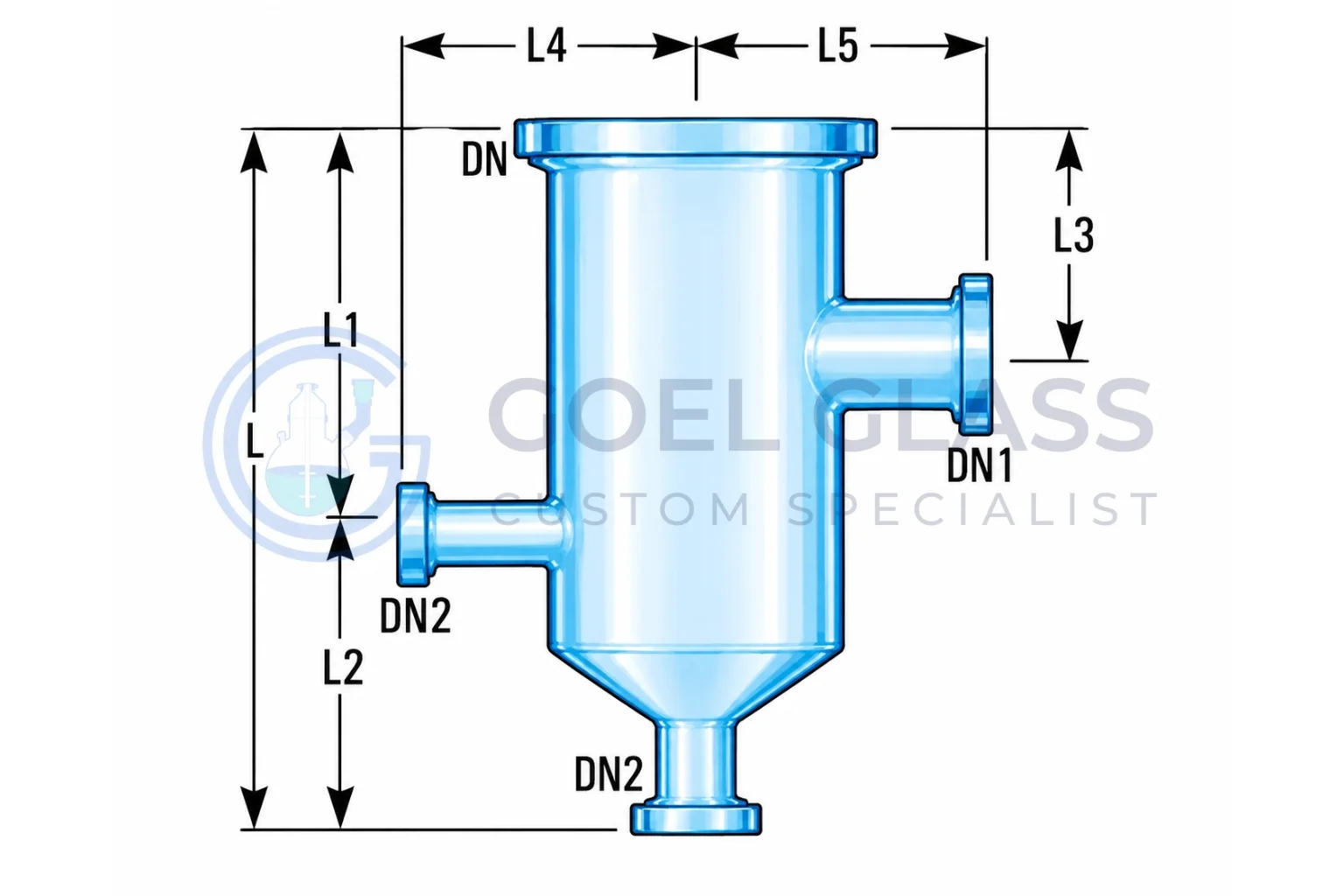
| CAT. REF. | DN | DN1 | DN2 | L | L1 | FREE CROSS SECTION CM2 | MAX. PRODUCT L/HR |
|---|---|---|---|---|---|---|---|
| RDA3* | 80 | 25 | 25 | 200 | 100 | 20 | 300 |
| RDA4* | 100 | 25 | 25 | 250 | 150 | 50 | 500 |
| RDA6* | 150 | 25 | 25 | 250 | 150 | 100 | 700 |
| RDA9* | 225 | 25 | 25 | 375 | 150 | 150 | 900 |
Note: DN2 is used for insertion of a thermometer pocket. A bellow is recommended on the distillate outlet DN1.
Magnetically Operated Reflux Dividers
For high-precision fractional distillation, Goel Glass manufactures Magnetically Operated Reflux Dividers (RHM Series). These units utilize an internally pivoted swinging glass funnel containing an encapsulated soft-iron core, actuated non-invasively by an external electromagnetic coil connected to an electronic digital process timer.
In its default de-energized state, the counterweighted funnel remains in the 100% total reflux return position, ensuring complete process safety. When energized by the timer, the magnetic field deflects the funnel to direct liquid into the distillate take-off channel. By setting precise energize/de-energize cycle intervals (from 1:1 up to 1:100), exact reflux ratios are reliably maintained without mechanical packing glands or vacuum leaks. Port DN2 allows thermometer pocket insertion, and installation of a liquid seal on distillate outlet DN1 is strongly recommended to isolate process vapors from the receiver.
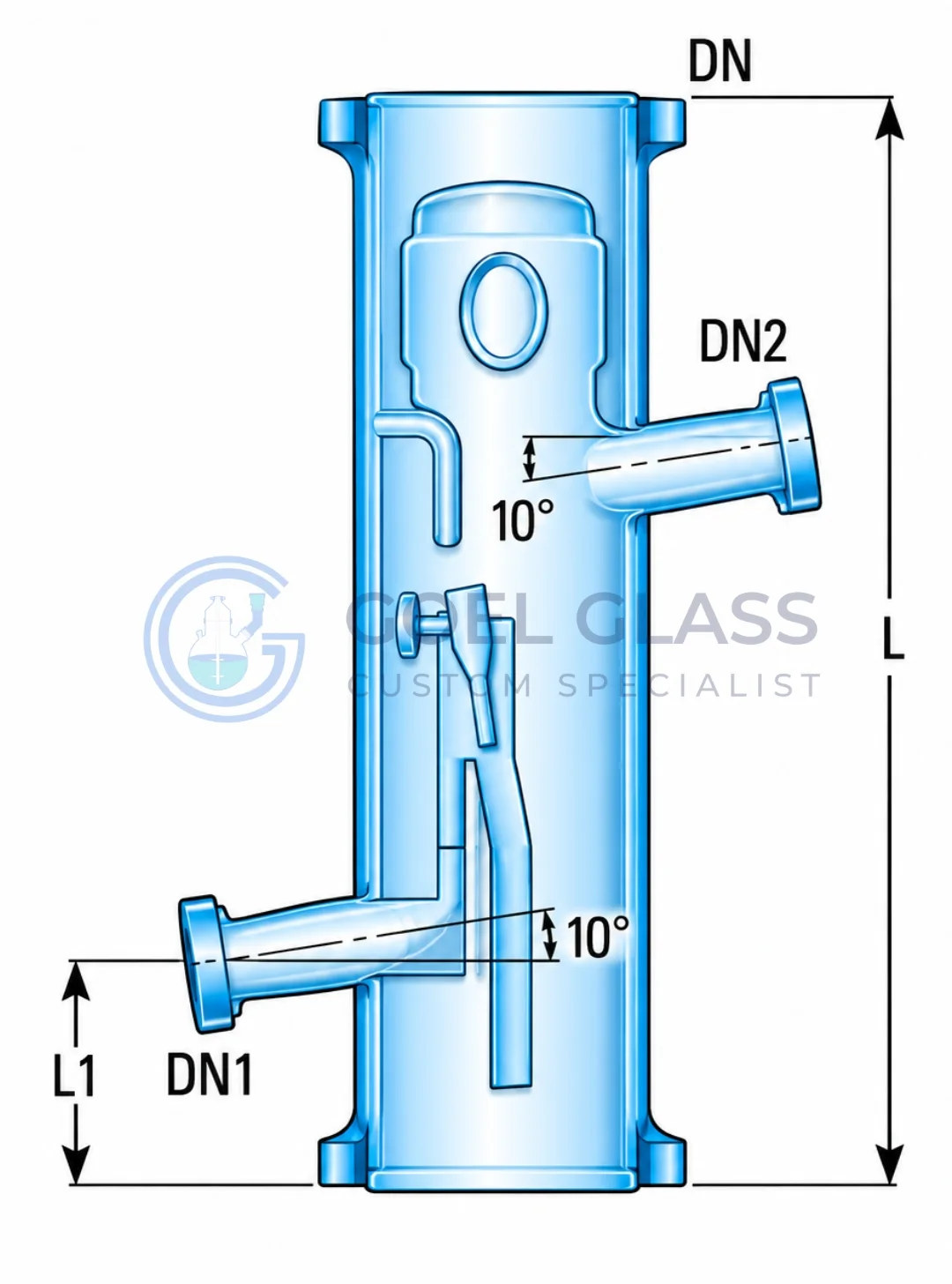
| CAT. REF. | DN | DN1 | DN2 | L | L1 | FREE CROSS SECTION CM2 | MAX. PRODUCT L/HR |
|---|---|---|---|---|---|---|---|
| RHM3 | 80 | 25 | 25 | 375 | 75 | 20 | 90 |
| RHM4 | 100 | 25 | 25 | 400 | 75 | 50 | 180 |
| RHM6 | 150 | 25 | 25 | 450 | 100 | 100 | 300 |
| RHM9 | 225 | 25 | 25 | 550 | 100 | 150 | 500 |
Pneumatic Reflux Dividers
Designed specifically for ATEX / explosion-proof environments where electrical solenoids cannot be positioned directly adjacent to flammable solvent vapor lines, Goel Glass Pneumatic Reflux Dividers (RPH Series) employ compressed clean air or nitrogen pulses to actuate the internal divider mechanism smoothly and reliably.
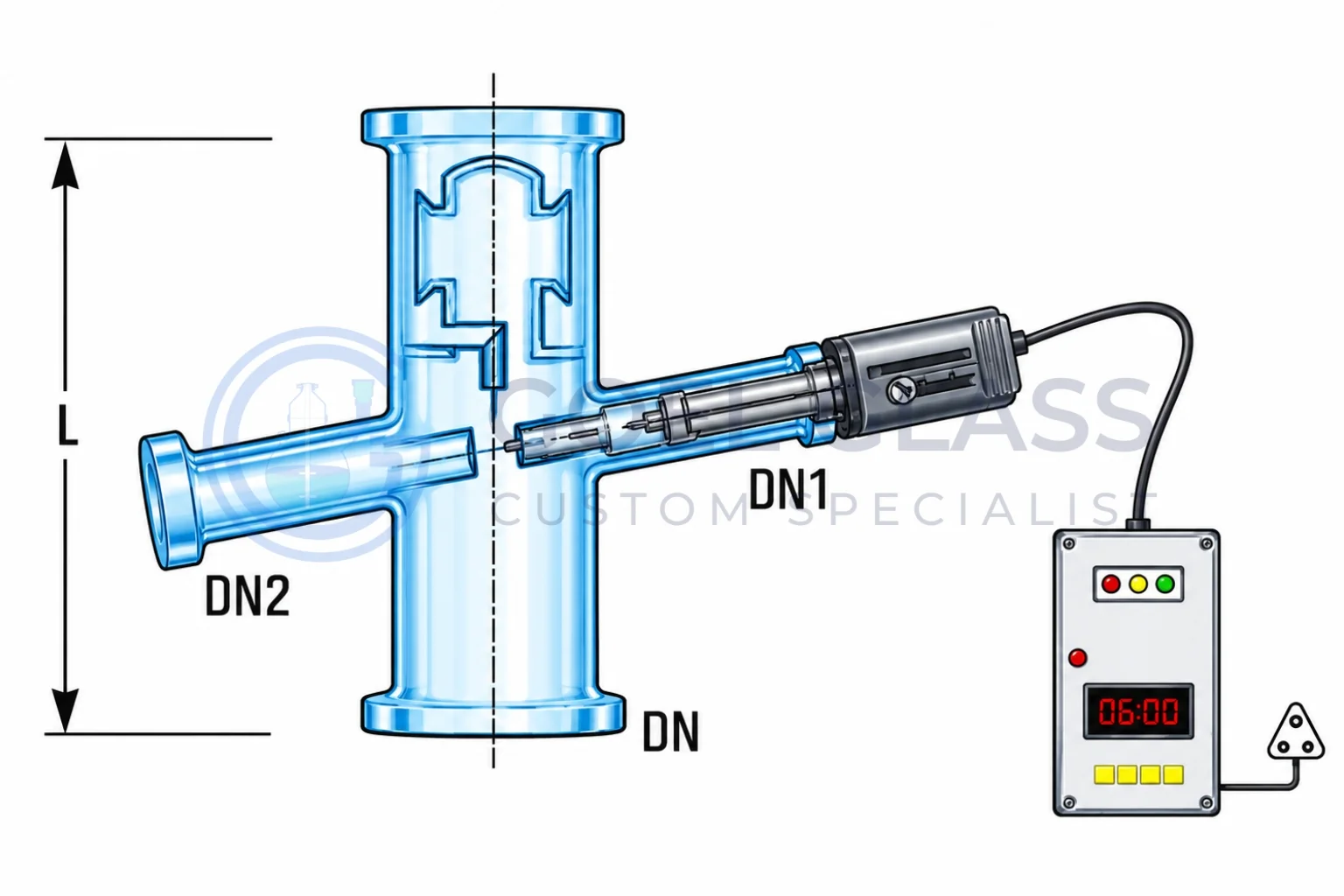
| CAT. REF. | DN | DN1 | DN2 | L |
|---|---|---|---|---|
| RPH3 | 80 | 25 | 25 | 250 |
| RPH4 | 100 | 25 | 25 | 250 |
| RPH6 | 150 | 40 | 25 | 250 |
| RPH9 | 225 | 40 | 50 | 375 |
Thermometer Pockets for Reflux Dividers
Goel Glass manufactured Borosilicate 3.3 thermometer pockets (TP Series) are engineered for direct insertion through port DN2 of reflux dividers or column sections. They provide a thin-walled, pressure-resistant protective sheath for RTDs and glass thermometers without impeding overhead vapor flow.
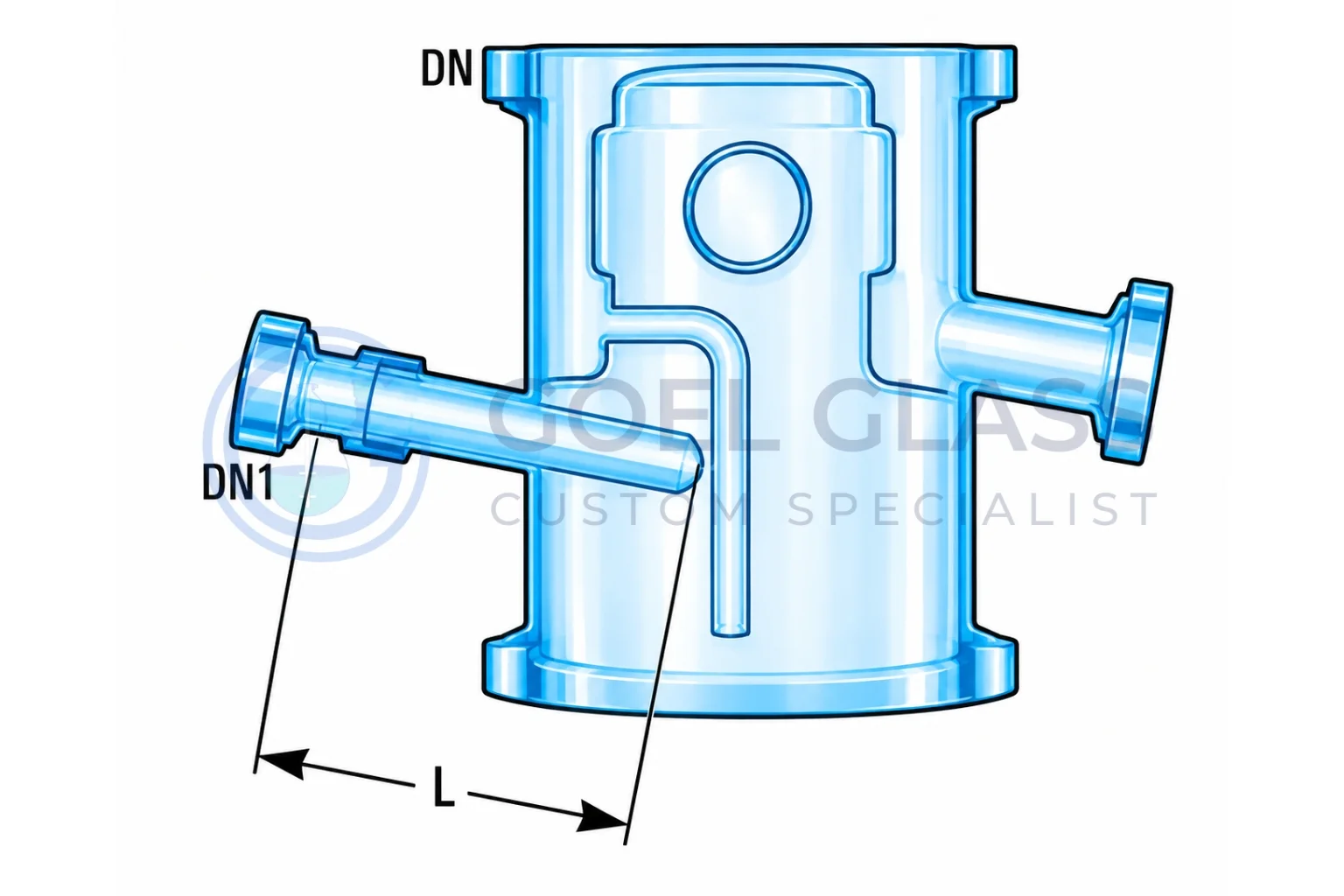
| CAT. REF. | DN | DN1 | d | L |
|---|---|---|---|---|
| TP3* | 80 | 25 | 12 | 75 |
| TP4* | 100 | 25 | 12 | 100 |
| TP6* | 150 | 25 | 12 | 125 |
| TP9* | 225 | 25 | 12 | 175 |
Borosilicate Glass Liquid Seals
Liquid seals (LS Series, Type A & Type B) are installed immediately downstream of the distillate outlet of reflux dividers. By maintaining a constant hydrostatic liquid barrier, they prevent uncondensed process vapors from bypassing into the distillate collection receivers or vacuum lines, ensuring stable column pressure and maximum solvent recovery.
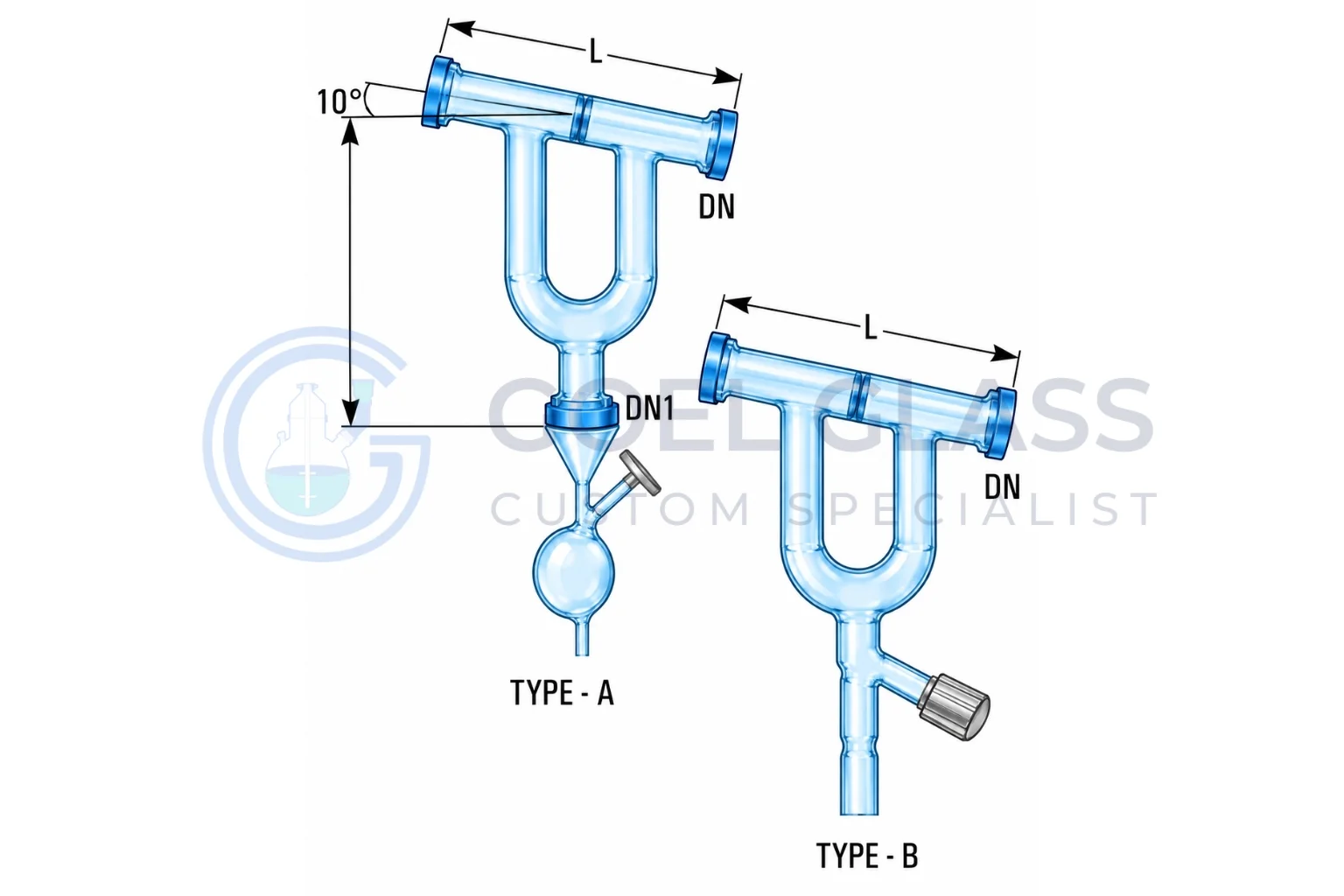
| CAT. REF. | DN | DN1 | L | TYPE |
|---|---|---|---|---|
| LS1* | 25 | 25 | 200 | A |
| LS1.5 | 40 | 25 | 300 | A |
| LSV1 | 25 | – | 200 | B |
Key Design Features
- Full Chemical Inertness: Wetted parts constructed from high-purity Borosilicate 3.3 and virgin PTFE, resistant to aggressive acids, halogenated compounds, and organic solvents.
- Precision Ratio Control: Electromagnetic and pneumatic actuation paired with digital timers allows continuous, repeatable reflux ratio adjustment from 1:1 to 1:100.
- Fail-Safe 100% Reflux: Default counterweight funnel design returns total condensate to the column in the event of power interruption or controller shutdown.
- Optical Verification: Transparent glass construction enables visual verification of funnel swinging, stream splitting, and distillate droplet flow rates.
- Vacuum Tightness: Hermetically sealed non-invasive magnetic actuation eliminates rotary seals, dynamic packings, and vacuum leak paths.
Industrial Applications
Goel Glass reflux dividers are deployed extensively in fractional distillation towers, solvent recovery systems, high-vacuum chemical rectification units, and cGMP pharmaceutical kilo-labs across Canada and the USA.