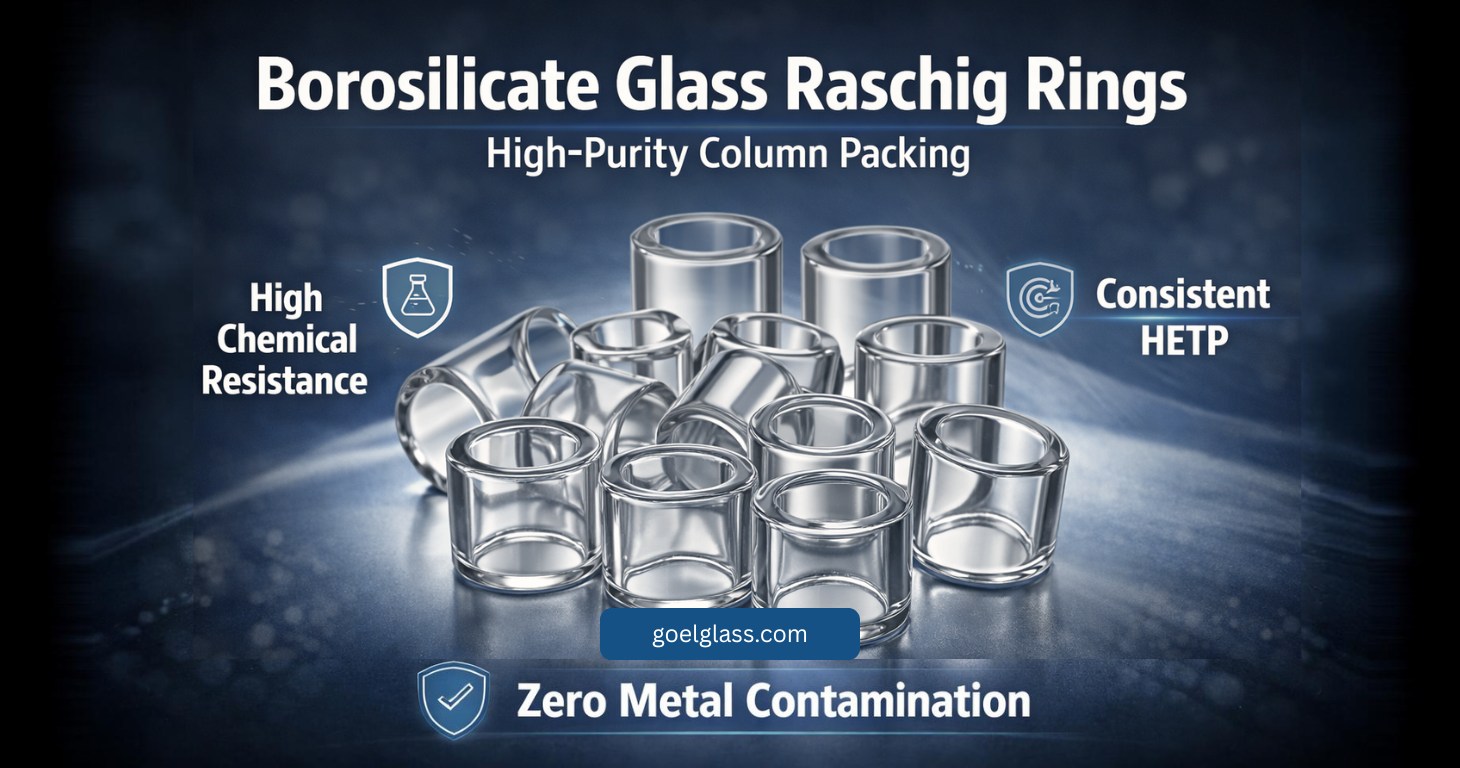
Fractional distillation is a constant battle between surface area and pressure drop. When you introduce aggressive acids or halogens into that equation, the balance becomes a severe operational liability.
In a controlled laboratory environment, almost any packing material survives a short run. But scale-up is where good chemistry dies. When you move a process to a pilot plant, standard stainless steel structured packing might offer excellent theoretical performance on paper. However, drop that same stainless packing into continuous hot hydrochloric acid, and it dissolves in days.
The vapor load originating from the primary Glass Reactor boiling flask carries highly corrosive media straight up into the column. If your packing material reacts with that rising vapor, you have chemically contaminated an entire batch before it even reaches the overhead condenser.
The Material Reality: Glass vs. Metal vs. Plastic
Process engineers sizing distillation column packing generally weigh three options: ceramic, polymer, and glass. Every material has an engineering limit you cannot ignore.
- Ceramic : Extremely dense and brittle. In a tall column, the sheer weight of a ceramic bed often crushes the lower packing layers. This destroys the void fraction and causes localized, unpredictable pressure spikes.
- Polymers (PTFE/Plastic) : Plastics solve the weight issue but introduce a thermal constraint. Under high thermal loads or vacuum fluctuations, plastic rings deform and flatten. This instantly floods the column.
- Borosilicate Glass: We specify borosilicate glass because it remains structurally rigid at high temperatures and is chemically static. Aside from hydrofluoric acid (HF) and hot concentrated alkalis, it resists everything. It guarantees zero metal ion leaching, preserving the exact chemical profile of the feed and preventing catalytic oxidation in the distillate.
Channeling and the Physics of the Bed
Dumping random media into a column does not guarantee separation. The physics of fluid distribution dictate that the packing size must be strictly proportional to the internal column diameter.
If you load standard Glass Raschig Rings into a mismatched column, the descending liquid naturally migrates toward the walls. This creates channeling a severe failure state where the rising vapor bypasses the liquid entirely, effectively destroying your separation efficiency.
To prevent this, specific column diameters require correctly proportioned rings fabricated by a specialized Custom scientific Glassware manufacturer. This dimensional precision maintains the correct void fraction across the entire cross-section of the pipe, forcing aggressive, continuous interaction between vapor and liquid.
HETP and Predictable Efficiency
The core objective in any distillation setup is achieving the lowest possible Height Equivalent to a Theoretical Plate (HETP).
Glass rings provide a uniform geometric structure that creates a highly predictable interface. As the reflux liquid cascades down the smooth silica surface, the rings break the fluid into a thin, continuous film. This dynamic maximizes mass transfer efficiency. Instead of over-engineering the column height to compensate for poor packing geometry and suffering energy-draining pressure drops as a result process engineers can calculate the exact height required to execute sharp, high-purity cuts.
Industrial Use-Case: Acid Recovery
Consider the demands of an industrial acid recovery system. A facility neutralizing and recovering hot sulfuric acid (H2SO4) cannot rely on exotic metal alloys without incurring massive capital expenses and ongoing corrosion monitoring.
In this environment, glass packing is not just an alternative; it is the baseline requirement. The rings must withstand the aggressive nature of the acid while maintaining enough open area to prevent the heavy fluid from choking the vapor path. Glass provides the necessary chemical armor while allowing operators to visually confirm that the bed is not fouling or flooding during operation.
System Integration and the Engineering Audit
A packed column is not a standalone device. It is a single node in a complex thermal and pressure loop.
When transitioning a process into production, the packed section must be integrated seamlessly into broader Industrial Glassware networks. This ensures your reflux splitters, adapters, and overhead condensers can handle the dynamic pressure load without flange failure or gasket blowouts. As an established industrial glassware supplier, we focus on matching the packing geometry to your exact thermal and chemical parameters, ensuring the entire system operates harmoniously.
Do not let a miscalculated pressure drop or hidden material corrosion ruin your yield. Audit your current column performance and consult the Goel Glass engineering team to calculate the exact ring volume required to hit your theoretical plates safely.
FAQs:
1. What is the advantage of Raschig Ring?
Raschig rings have long service lives due to superior resistance to aggressive acids, organic solvents, and conditional caustic solutions per DIN ISO 3585. High strength design reduces fouling and stagnation. Additionally, they resist damage from extreme temperatures and physical shock. High capacity and separation efficiency.
2. Where can I purchase Borosilicate Glass Raschig Ring?
Glass Raschig are available from specialist vendors and manufacturers, such as Goel Glass. Contact us website using keyword “Industrial Glassware” near me for renowned high-quality equipment.
Looking for top-grade Glass Raschig Ring ? Contact us at Goel Glass for the finest lab Glassware including Glass ring . Our experts will assist you with the best recommendations.
3. What is disadvantage of Pall Raschig ring?
The main drawback to pall rings is their limited capacity for liquid redistribution. while the limitations and disadvantages of borosilicate include its brittleness and higher cost compared to other types of glass
4. Are glass Raschig Ring customizable?
Yes. Glass Raschig Ring can be customized to meet specific process needs and safety regulations.
5. Difference between Pall Ring & Glass Raschig Ring.
A Pall ring has the same diameter and height, but is different from a Raschig ring in design several portions of the side wall are cut and bent inward so that a gas and a liquid can more efficiently come into contact with each other, achieving a lower pressure loss and a lower HETP than those of a Raschig ring.
6. How to clean Raschig ring ?
- Add hot water to Distiller Equipment Cleaner (150-180'F; 1/2 - 1 oz Equipment Cleaner per gallon of water) then put the Raschig Rings in the mixture.
- Soak the Ceramic Raschig Rings for half an hour.
- Thoroughly rinse using Distiller Equipment Rinse or with clean water.
Dimension And Other Physical Properties
| CAT. REF. | SIZE | BULK DENSITY KG/LTR | SPECIFIC SURFACE M2/M3 | GLASS |
|---|---|---|---|---|
| FC8 | 8x8 | 0.66 | 633 | Borosilicate |
| FCB10 | 10x10 | 0.52 | 487 | Borosilicate |
| FCB12 | 12×12 | 0.48 | 425 | Borosilicate |
| FCB15 | 15×15 | 0.43 | 330 | Borosilicate |
| FCB20 | 20x20 | 0.30 | 300 | Borosilicate |
| FCB25 | 25x25 | 0.28 | 240 | Borosilicate |
| FCB30 | 30x30 | 0.27 | 180 | Borosilicate |
| FCB40 | 40×40 | 0.22 | 160 | Borosilicate |
| FCB50 | 50×50 | 0.19 | 120 | Borosilicate |
Your frequently asked question
The amount of glass Raschig rings needed for your column will depend on several factors, including the diameter of the column, the desired bed height, and the void space of the rings.
Here are some resources that can help you calculate the amount of rings needed:
Packing calculators offered by Raschig ring manufacturers
Engineering reference books on distillation and absorption columns
Yes, in many cases, glass Raschig rings can be reused. However, there are a few factors to consider:
Chemical Compatibility: If the rings have been exposed to harsh chemicals or solvents that could damage them, they should not be reused.
Physical Condition: The rings should be inspected for cracks, chips, or other signs of wear and tear. Damaged rings can affect column performance and should be replaced.
Contamination: If the rings have become contaminated with unwanted materials, they may need to be cleaned or replaced.
This taps into a practical question users might have about packing the column. Briefly explain that typically, uniform ring size is used throughout the column. However, in some specific applications, tapered packing with larger rings at the bottom and smaller rings at the top might be used for reasons like improved liquid distribution.
The choice of packing for distillation & absorption is discussed in details.In general , the largest size of column should be used up to 50mm.Small sizes are appreciably more expensive than larger sizes.