Industrial Borosilicate Wiped Film Evaporators (WFE)
Heat-sensitive compounds—including natural vitamins, active pharmaceutical intermediates, botanical essences, and temperature-labile biomolecules—experience severe thermal cracking and color degradation when exposed to extended boiling in conventional bulk reboilers. Goel Glass manufactures precision-engineered Borosilicate Glass Wiped Film Evaporators (WFE) specifically designed to lower boiling temperatures through deep vacuum operation while drastically reducing liquid residence time to mere seconds.
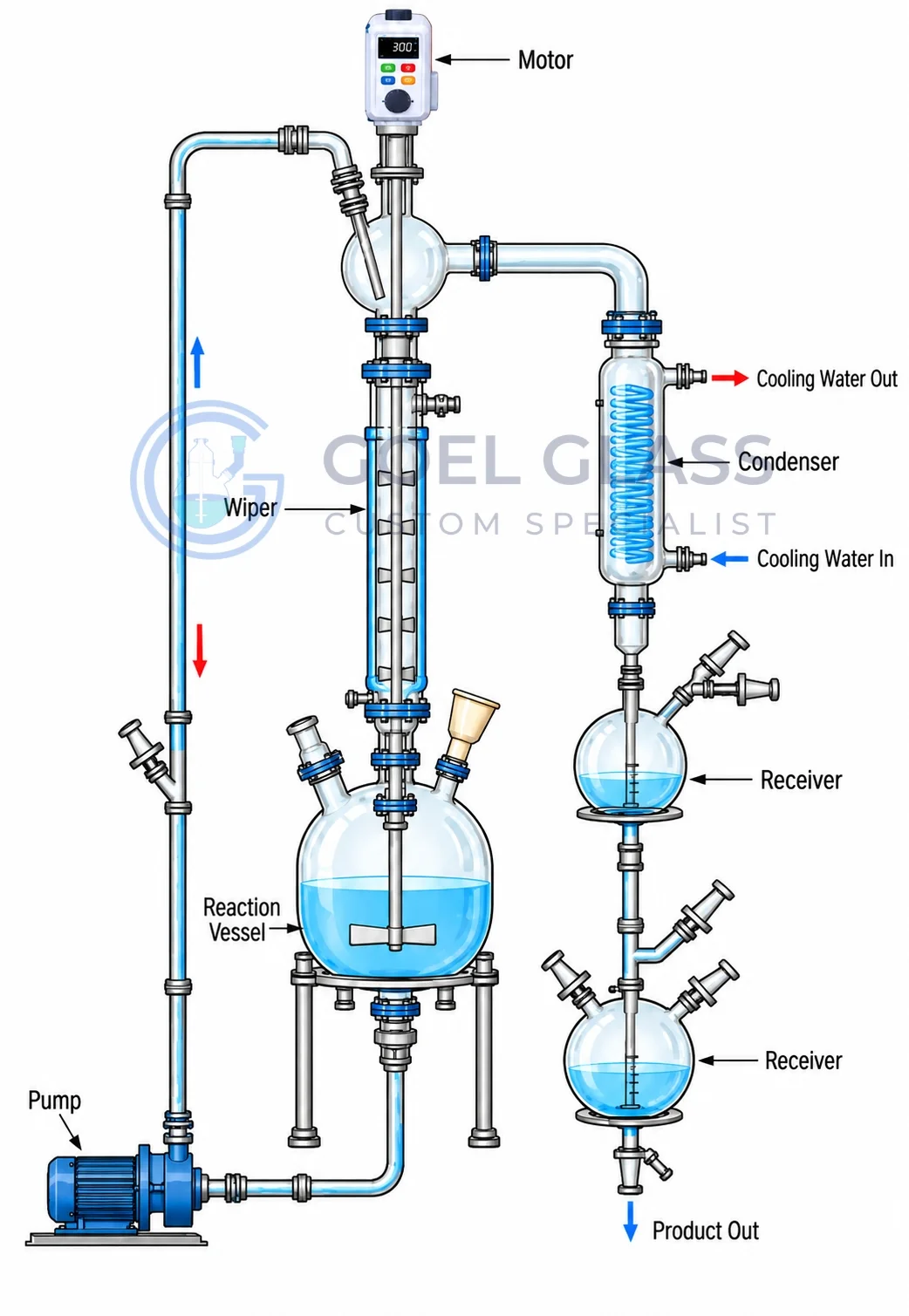
The system comprises a precision-bore Borosilicate 3.3 jacketed glass evaporator cylinder, an overhead centrifugal liquid distributor collar, and a motorized central rotor driving four rows of vertically segmented virgin PTFE wiper blades. Raw feed introduced at the top is uniformly dispersed across the inner perimeter of the heated cylinder. The rotating wiper blades continuously wipe and renew an ultra-thin, highly turbulent fluid film (0.1 mm to 0.5 mm thick), maximizing conductive heat transfer coefficients while rapidly flashing off volatile fractions without hot-spot formation.
Engineered Construction & Drive Mechanism
The wiper assembly is constructed entirely from chemical-grade Borosilicate glass support rods and pure virgin PTFE wiper blades, delivering absolute corrosion resistance against hot acids, halides, and aggressive solvents. Overhead motor agitation is driven by a variable-speed geared drive motor with an AC frequency inverter, coupled with a hermetic high-vacuum mechanical shaft seal rated for deep vacuum service.
Thermal fluid heated up to 150°C is continuously circulated through the outer glass jacket. Overhead vapors pass into an attached descending glass coil condenser and graduated receiver assembly, while concentrated bottom residues discharge continuously through a vacuum-balanced bottom receiver or peristaltic discharge pump.
| MODEL | SIZE DN (mm) | HTA(M2) |
|---|---|---|
| WFE3 | 80 | 0.35 |
| WFE4 | 100 | 0.47 |
| WFE6 | 150 | 0.70 |
Key Engineering Features
- Minimal Residence Time: Fluid exposure is restricted to a few seconds, preventing thermal cracking.
- PTFE Wiper Blade Segments: Self-cleaning hinged blades maintain uniform thin film even with viscous feeds.
- High Heat Transfer Coefficients: Continuous turbulence created by wipers prevents surface fouling and hot-spots.
- Deep Vacuum Capability: Operates down to 0.1 mbar for gentle low-temperature distillation.
Industrial Applications
- Cannabinoid & Hemp Distillation: Short-path terpene and solvent stripping without cannabinoid degradation.
- Vitamins, Flavors & Aromas: Refining delicate essences, tocopherols, omega fatty acids, and fragrances.
- Polymer & Resin Devolatilization: Stripping residual monomers and solvents from high-viscosity prepolymers.
- High-Boiling Intermediate Refining: Separating close-boiling fine chemicals prone to decomposition at atmospheric pressures.
FAQs
Another name for a wiped film evaporator is a thin film evaporator. Both terms refer to the same type of evaporator that uses a rotating wiper blade to create a thin film of liquid on the inner surface of the evaporator's walls.
The core of the unit is a rotating, fully corrosion resistant wiper system. This has four rows of PTFE wipers. These rows of wipers are divided into vertical segments and each wiper is mounted between two glass rods.
The cost of a wiped film evaporator can vary depending on factors such as size, material, and features. For specific pricing information, it's best to contact us directly.
Goel Glass Company leverages its extensive expertise in scientific glass fabrication & its proficiency in catering to diverse chemical processing industries to create a state-of-the-art system with several distinct advantage
Yes, the evaporator can be customized to accommodate specific production requirements and space limitations.
A wiped film evaporation machine consists of three main parts: a feed inlet at the top of the device, rotor blades inside a cylindrical heating jacket, and outlets or discharge nozzles for product concentrate and vapor.