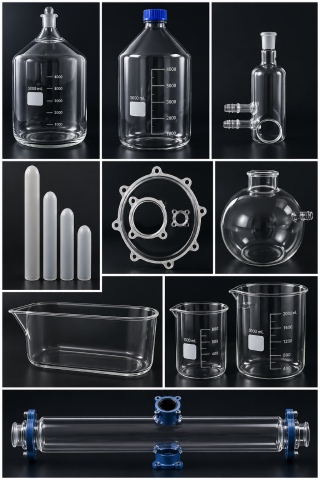
Custom Scientific Glassware Fabrication
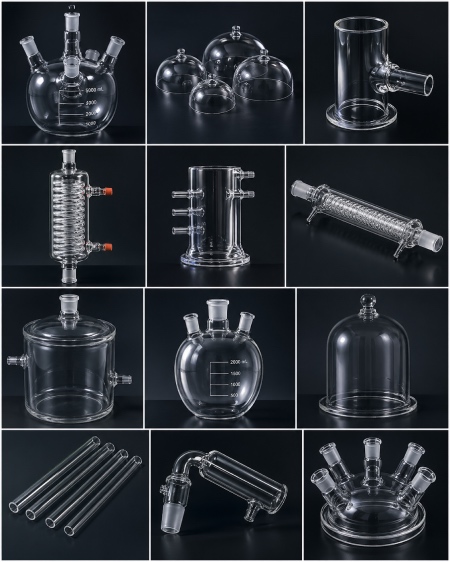
Beyond our standard catalog of process and laboratory equipment, Goel Glass specializes in custom scientific glassware fabrication tailored to exacting research, pilot plant, and OEM specifications. Whether you need modifications to an existing vessel, intricate multi-stage distillation heads, custom jacketed glassware, or one-off experimental apparatus, our team combines decades of specialized scientific glassblowing with modern CNC lathe operations.
Every custom component is fabricated from premium Borosilicate glass (DIN ISO 3585 / ASTM E438 Type I Class A) or high-purity fused quartz, ensuring exceptional chemical durability, optical clarity, and thermal shock resistance.
Download Custom Glassware Capabilities Brochure
Technical specifications, joint geometries, and fabrication examples.
Our Custom Fabrication & Quality Workflow
1 Enquiry & Technical Review
Submit dimensioned 2D/3D CAD drawings (STEP, DWG, PDF) or physical samples. We review operating conditions including temperature ranges, operating pressures, vacuum limits, and fluid compatibility.
2 Engineering Approval
Our engineers verify wall thicknesses, joint selections (standard taper, spherical, or QVF beaded), and thermal stress distribution, issuing formal sign-off drawings before production.
3 Precision Glassblowing
Components are hot-worked using precision glass lathes, specialized burner arrays, and optical alignment fixtures to ensure exact concentricity and joint geometry.
4 Computerized Lehr Annealing
Every completed glassware assembly is processed through a programmed annealing oven up to 565°C followed by controlled cooling to completely eliminate residual internal stresses.
5 QA, Polariscope & Pressure Testing
All parts undergo optical polariscope stress inspection, dimensional verification against approved drawings, and vacuum or hydrostatic pressure testing prior to dispatch.
Frequently Asked Questions
We accept standard engineering CAD drawings (DWG, DXF, STEP, IGES, PDF) as well as dimensioned hand sketches or physical sample components. Our engineering team will produce a certified production drawing for your formal sign-off before manufacturing begins.
Yes. We regularly fabricate single prototype units for research institutions, pilot plants, and OEM development projects. Once validated in service, we can scale to repetitive small-batch or volume production with identical dimensional fidelity.
For standard lathe-worked borosilicate components, overall linear dimensions are typically maintained within ±1.0 mm to ±2.0 mm depending on vessel diameter. Ground glass taper joints (ISO 383 / DIN 12242) and precision-bored tubing surfaces are finished to within ±0.05 mm to ensure vacuum-tight integrity.
Yes. We routinely engineer composite assemblies including virgin PTFE seals, zero-dead-space drain valve plugs, glass-to-Kovar or platinum electrode seals, and fluoropolymer-lined stainless steel backing flanges for process plant integration.